Europe Nook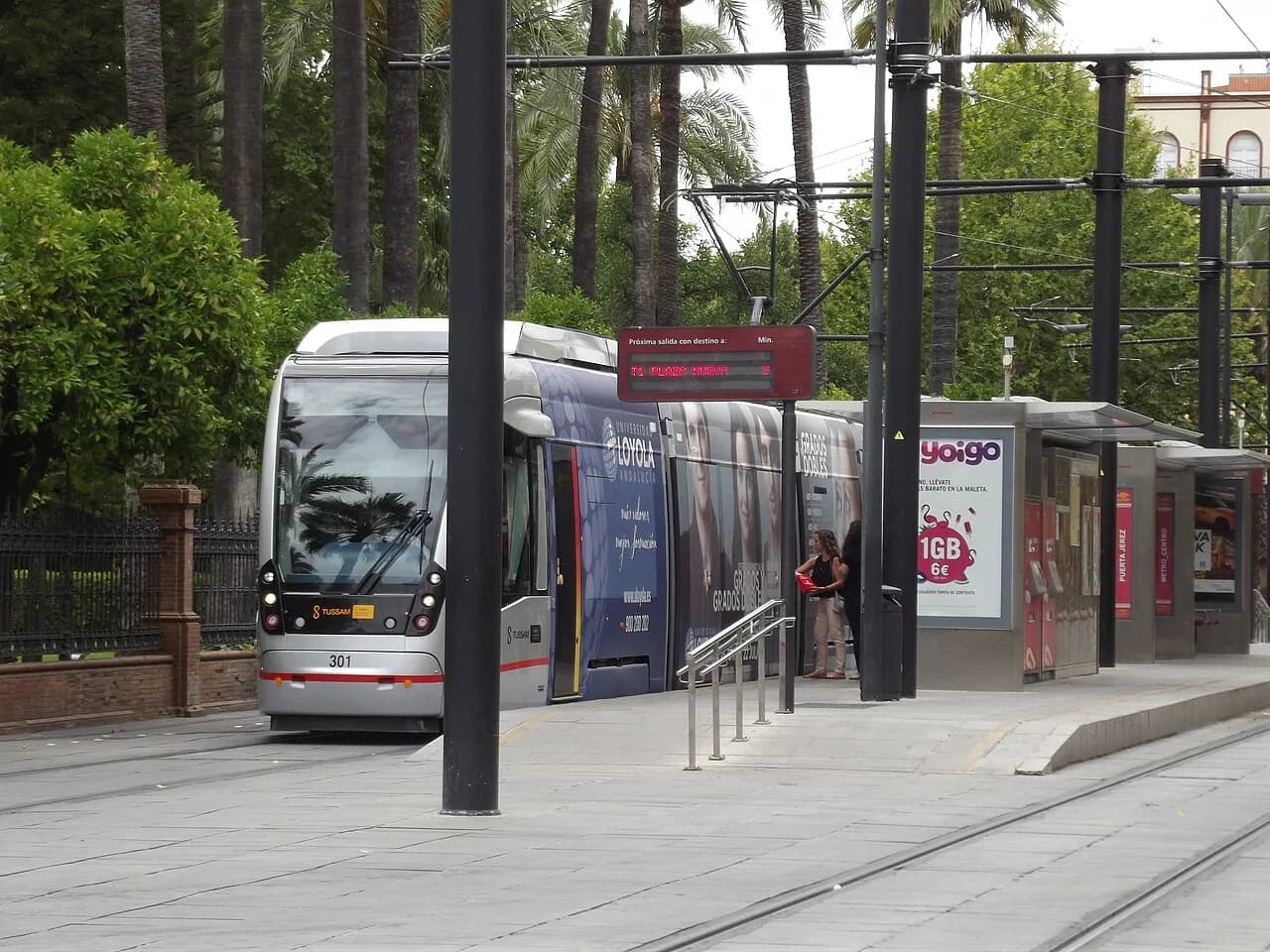
Last updated September 2026. For a central Seville stay, start with walking for nearby sights, then choose the bus, tram or metro that actually serves your destination. These seven options include walking and bike share alongside public transport: they are travel choices, not seven separate networks. Airport journeys need their own fare, and a TUSSAM card is not the same product as a Metro ticket.
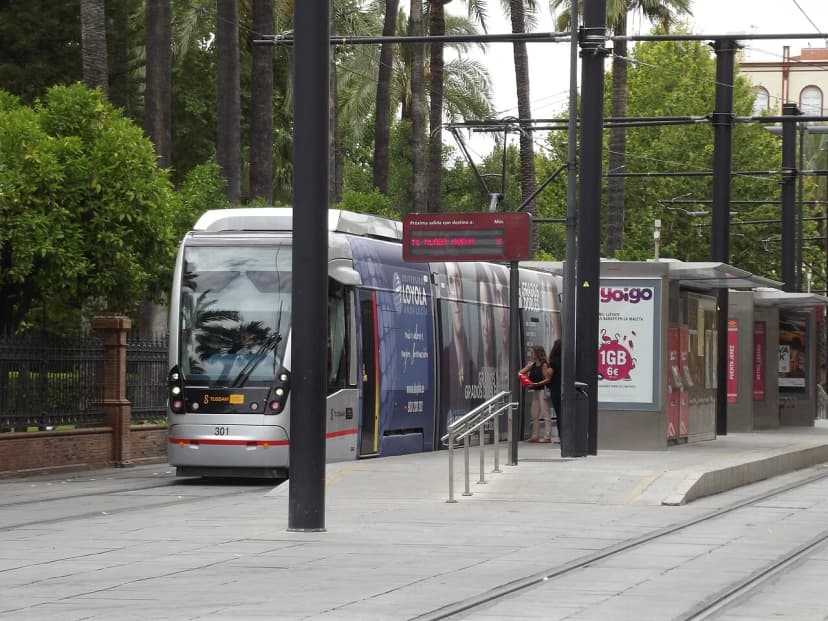
Historical MetroCentro tram at Puerta Jerez; the Plaza Nueva display is not evidence of current service. Photo: Elliott Brown, CC BY-SA 2.0, via Wikimedia Commons. Resized and converted to WebP.
Quick Answer: Which Seville Public Transport Option Should You Use?
Choose by the door-to-door route, including the walk to the stop and any interchange. A cheap fare is little help if it leaves you across town with bags. The comparison gives published starting costs rather than promised journey times; the ticket section explains deposits, transfers and pass limits.
| Option | Starting cost | Useful for | Main limitation |
|---|---|---|---|
| Walking | No transport fare | Nearby old-town sights | Heat, paving, distance and bags |
| Sevici bike share | €2.59 one-day subscription | Short rides between docking stations | First 30 minutes per hire included; longer rides cost extra |
| MetroCentro tram (T1) | €1.40 ordinary single | Cathedral-side corridor, Prado, San Bernardo and Nervión | Check the temporary city-centre terminus |
| Metro Line 1 | €1.35 / €1.60 / €1.80 single | Puerta Jerez, Prado, San Bernardo, Nervión and outer districts | Fare depends on 0 / 1 / 2 zone boundaries crossed |
| Ordinary TUSSAM bus | €1.40 single | Routes beyond the rail corridors and station connections | Direction, stop and traffic matter |
| Taxi | Applicable meter tariff | Luggage or a nearer accessible drop-off | No universal short-trip price or speed guarantee |
| EA airport bus | €6 single | Airport to selected city stops | Separate airport tariff; no included onward transfer |
7 Ways to Get Around Seville
For each journey, check your destination first, then the service and ticket. Do not treat a similar name, a map of future extensions or an old destination display as proof of today's route.
- 1. Walk between nearby sights
- The cathedral, Alcázar surroundings and Santa Cruz lanes can be combined on foot when the distances suit you. Centro and Triana are not uniformly pedestrian-only: expect roads, crossings and delivery access.
- Use the self-guided walking tour to organize a route, then shorten it for heat, luggage or mobility needs. A central address does not guarantee a level, shaded approach.
- 2. Use Sevici for short dock-to-dock rides
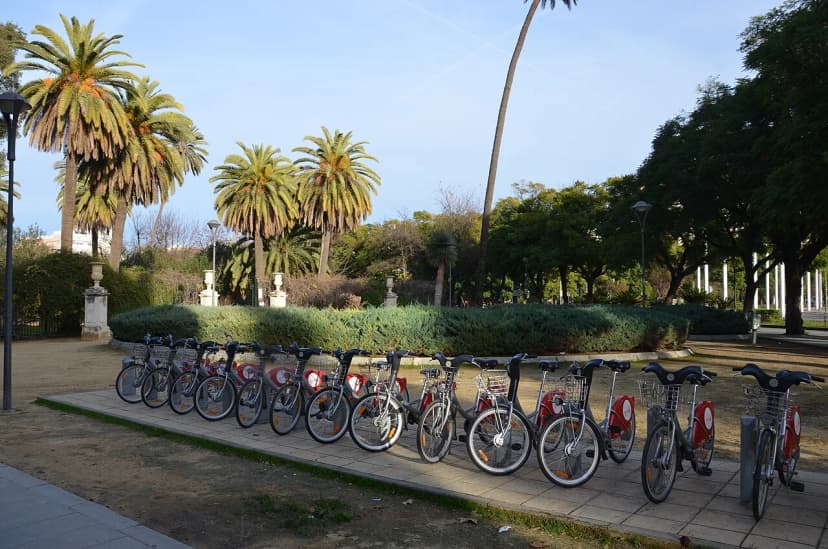
- The Sevici operator offers a €2.59 one-day subscription and €13.33 seven-day subscription, with the first 30 minutes of each hire included. These are not unlimited-duration bike rentals.
- Check a free destination dock before setting off and confirm the return has registered. The Seville bike rental guide separates bike-share subscriptions from shop rentals, extra-time charges and riding restrictions.
- 3. Take MetroCentro along its central corridor
- The T1 tram reaches beyond the cathedral area through Prado and San Bernardo toward Luis de Morales in Nervión. It is a useful connection beyond the short cathedral-side stretch shown in older descriptions.
- Works have curtailed the city-centre end at Archivo de Indias. The municipality's works notice records the Plaza Nueva closure; Diario de Sevilla's 24 August 2026 report confirms it was still curtailed then. Do not plan boarding at Plaza Nueva without a fresh TUSSAM check.
- See the Seville tram guide for the corridor and boarding process; current TUSSAM service information takes precedence over historical maps or photographs.
- 4. Use Metro Line 1 when its stations fit
- Line 1 serves useful central-area stations including Puerta Jerez, Prado de San Sebastián and San Bernardo, as well as Nervión and destinations farther out. It is not a service only for suburbs, but it does not run through every old-town neighborhood.
- Choose the correct saltos fare and validate at entry and exit. The Seville metro tickets guide explains the separate Metro system; the operator's ticket page provides the fare reference.
- 5. Choose a TUSSAM bus for the missing connection
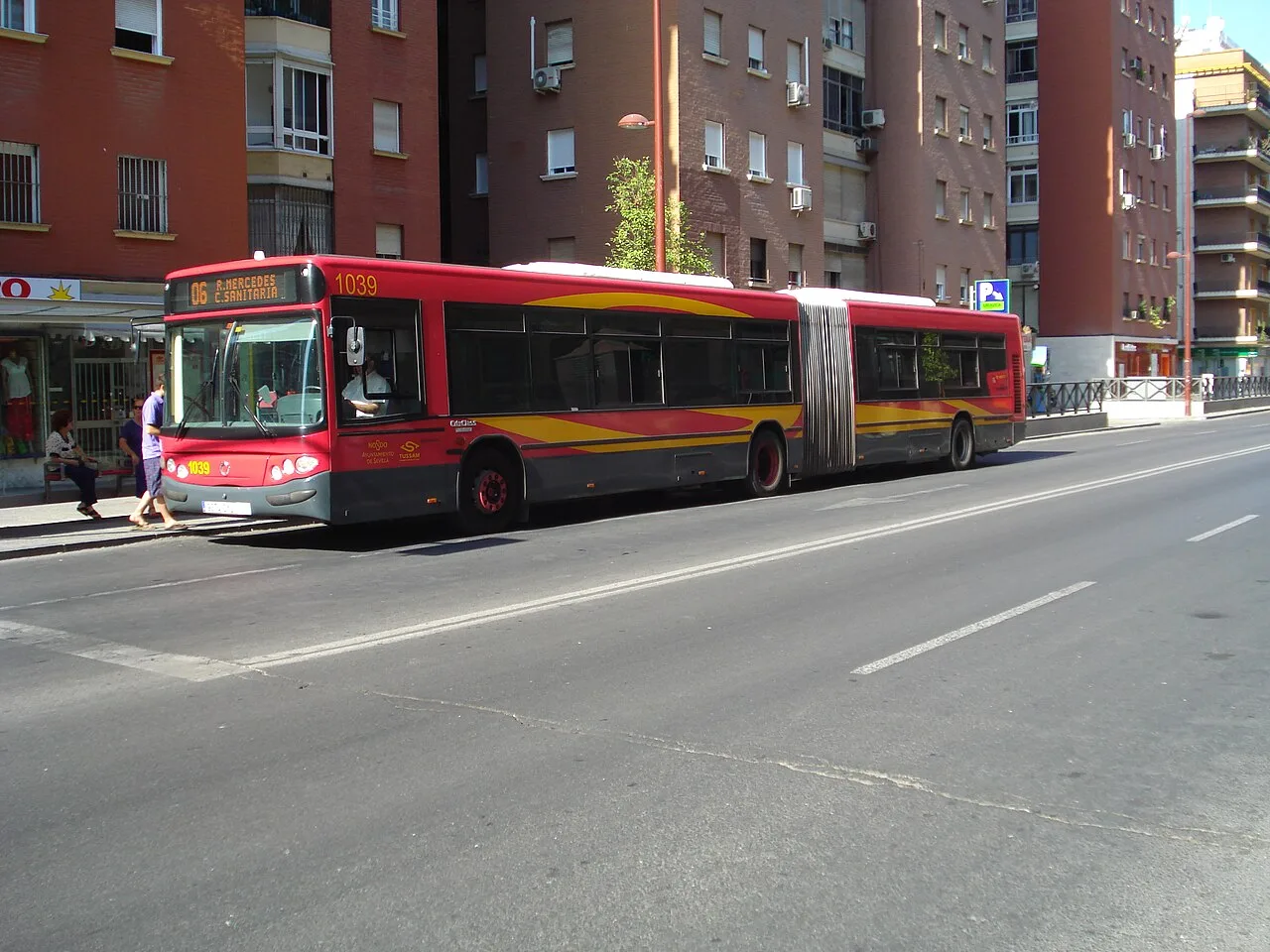
- Buses fill gaps outside the tram and metro corridors. Check the actual stop and direction: a circular line does not necessarily enter the historic lanes or connect the two terminals you need.
- Line 21 is a useful Santa Justa–Plaza de Armas connection, covered in the Seville bus station guide. Buy an ordinary single on the bus or validate an eligible card when boarding. Retain the ticket for inspection.
- 6. Take a taxi for an appropriate drop-off
- A taxi can reduce transfers with bags, but street restrictions can still leave a final walk. Ask the accommodation where vehicles can stop, particularly inside the old town.
- City trips use the relevant urban meter tariff. Airport trips have distinct tariff rules and still require the meter; the 2026 official taxi tariff is the source, not a universal online quote for a short ride.
- 7. Treat the EA as a separate airport service
- The airport bus serves stops including Santa Justa, Prado and Plaza de Armas. Aena's bus information confirms €6 one-way and €8 return valid only on the purchase day.
- For a normal holiday with the return flight on another date, budget two singles. See the airport-to-city-centre guide for direction-specific stops and the dated timetable; do not assume a city pass includes the EA.
Airport to Seville City Centre: Bus, Taxi, or Rental Car
First locate your accommodation against the EA stops. Count waiting, the bus ride and the final walk separately. For a cross-city bus journey, allowing 45–60 minutes aboard is an editorial planning buffer, not an operator guarantee; add time for waiting and walking. Traffic can affect both buses and cars.
- EA bus: a lower direct fare
- One-way fares for three people total €18 and for four total €24. Both are below the usual direct airport taxi tariffs, so splitting a taxi does not automatically make it cheaper.
- A card accepted as payment on the EA does not turn its fare into an ordinary city-bus fare. Onward tram, city bus or Metro travel is a separate ticket decision.
- Taxi: convenience at a separate tariff
- The official airport tariffs are €26 under tariff 4 and €29 under tariff 5, according to time/day and special-period conditions. The meter is compulsory. Telephone collection and onward additional destinations have specific rules; check the airport guide before assuming every booked trip is the same fixed total.
- A vehicle with suitable capacity may simplify a group arrival, but confirm passenger and luggage space. Neither an immediate vehicle nor a faster door-to-door journey is guaranteed.
- Rental car: decide from the wider itinerary
- For a city-only stay, parking and access restrictions can outweigh any benefit. If a later rural itinerary needs a car, compare collecting it when leaving Seville rather than paying to park it throughout the city visit.
Map: Prado coach-terminal area for orientation, not the exact boarding bay or Metro entrance. Follow the signs and your operator's instructions.
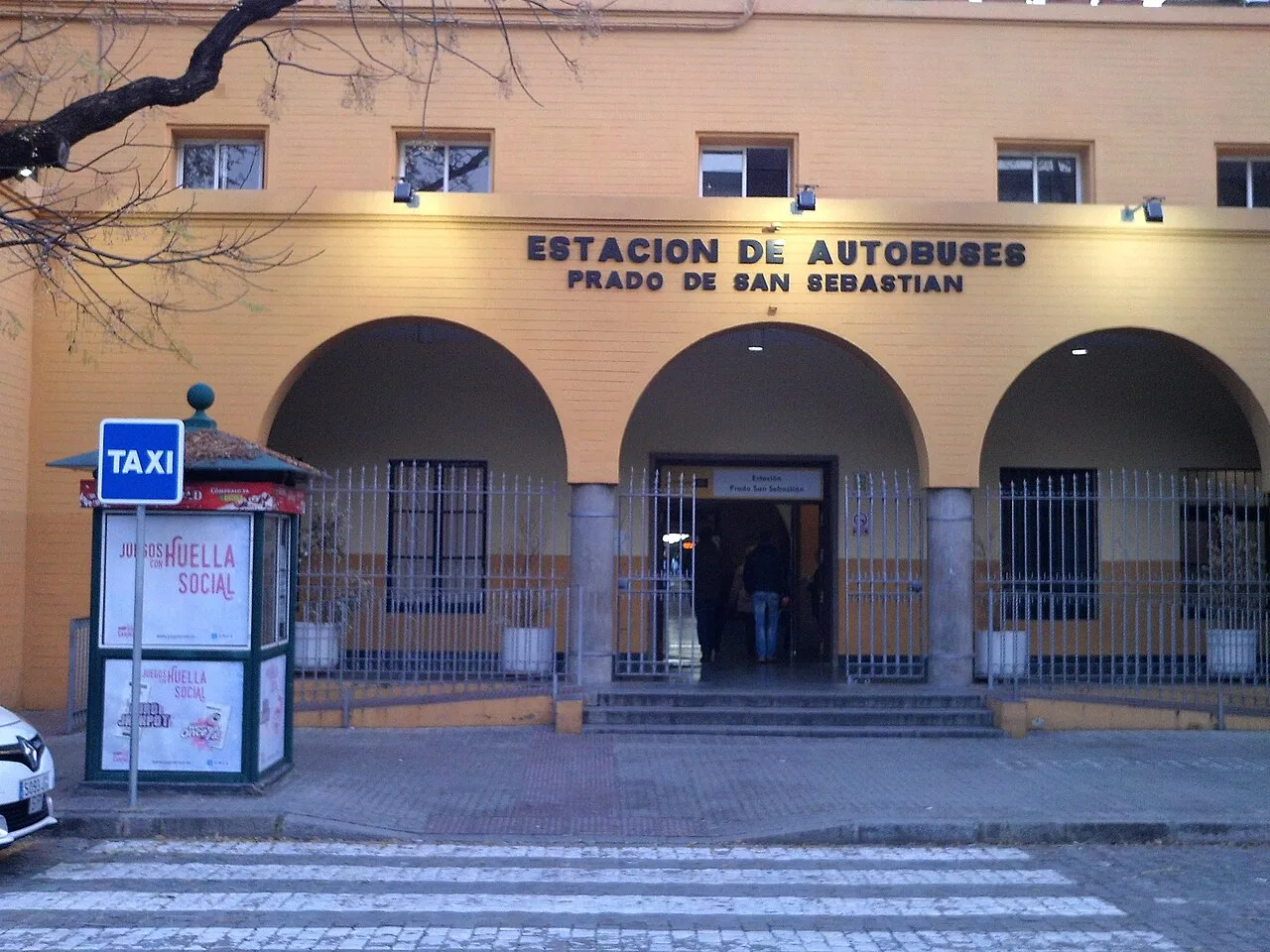
Untangling Santa Justa, Plaza de Armas, and Prado de San Sebastián
These names refer to different places. Read the station or terminal on the actual booking; a ticket that says Sevilla in the search results is not enough to choose a departure point.
- Santa Justa: railway station
- Santa Justa handles mainline trains, including Renfe services to Madrid and Córdoba. It is not the coach terminal and has no direct airport railway.
- Walking may suit some hotel locations; luggage and heat can make a bus or taxi preferable. Use the Santa Justa train station guide for the arrival-to-onward-connection steps.
- Plaza de Armas: coach and regional bus terminal
- This is a separate terminal near the river on the city-centre side, not Santa Justa and not the historic railway building with a similar name. It serves intercity coaches and regional routes; the booked operator determines where to board.
- The bus station guide distinguishes terminal access from nearby TUSSAM stops and explains the Line 21 connection.
- Prado de San Sebastián: coach terminal and nearby interchange
- The coach-terminal building is distinct from the surrounding city-bus stops, Metro station and tram stop. A direction to Prado can mean any of those, so confirm the mode as well as the place.
- Do not assume a regional coach boards at a TUSSAM city-bus shelter. Use the operator's boarding instructions and the terminal display.
Choosing a Ticket or Transport Card
Keep the products separate. The table uses TUSSAM's current fare list for city services and the Metro operator's tariff for Line 1. Discounted stored-value fares are not the same as single tickets or an unlimited pass. The transport card guide covers the buying decision in more depth.
The dedicated one-day and three-day tourist-card pages both specify a €2 deposit. Some older TUSSAM guidance still says €1.50. Budget €2 and confirm the receipt/refund conditions at purchase; do not count a deposit refund as cash already returned.
TUSSAM's tourist-card conditions define calendar days starting with first use, regardless of the hour. These are not rolling 24/72-hour passes: activating late in the evening uses that first calendar day. The PDF's older deposit figure is superseded for this guide by the dedicated product pages.
Compare actual spending, not just the pass label. Excluding card costs, four €1.40 singles cost €5.60, above the €5 day pass; but ten €0.41 stored-value journeys cost only €4.10. With no-transfer Multiviaje, the day pass's fare-only break-even is 13 rides; the three-day pass's is 25 rides across its validity. Transfers, deposits and leftover credit change the real comparison.
Multiviaje has a €7 minimum reload and unused credit is not refunded under TUSSAM's card conditions. For a very short visit, a low per-ride charge can still leave money unused. Metro Bonometro has different loading rules; do not confuse it with the separate 45-journey Bono Plus 45.
Consorcio regional cards have their own acceptance and fare rules. Compatibility with a validator does not mean every mode is included for one flat price. Count airport, regional and city journeys separately before choosing a card.
| Product | Published fare or price | Scope and extra cost |
|---|---|---|
| TUSSAM ordinary single | €1.40 | One ordinary bus or tram ride |
| TUSSAM Multiviaje | €0.41 without transfer / €0.46 with transfer | Stored value; transfer version allows a different line within one hour; card deposit extra |
| TUSSAM tourist 1 / 3 days | €5 / €10 | Ordinary TUSSAM buses and tram; individual use; deposit extra; excludes EA and special services |
| TUSSAM 30-day card | €21.20 | Personalized city product; €2 processing fee; not the airport monthly product |
| Metro single, 0 / 1 / 2 saltos | €1.35 / €1.60 / €1.80 | Line 1 only; initially €0.30 for reusable ticket support |
| Metro Bonometro, 0 / 1 / 2 saltos | €0.49 / €0.70 / €0.82 | Discounted stored-value product; €10 minimum top-up |
| Metro one-day ticket | €4.50 | Individual; purchase day, not rolling 24 hours |
Walking and Biking: When to Skip Public Transport Entirely
For two nearby old-town sights, compare the walk with the walk to a stop plus the wait. The walking route is a planning aid, not a requirement to finish every stop. Split the route around meals and shade, or take transport for the longer return leg.
Bikes are more useful when a legal cycling route and available docks fit both ends. Dismount where riding is restricted or pedestrian conditions require it. The bike guide explains subscriptions, private rentals and route constraints without treating the whole riverside or old town as an unrestricted cycle lane.
Accessible Transportation in Seville
The Metro accessibility page describes lifts linking street, concourse and platforms, wide gates and low-floor trains. Infrastructure provision is not proof that every lift is working today. Check the operator's station-specific equipment information, such as Puerta Jerez's live station page, before relying on a particular entrance.
For bus or tram travel, confirm the relevant boarding arrangement and any assistance needs with TUSSAM. A wheelchair space, ramp or low-floor design is not a guarantee of an immediately available place.
Check the last stretch to the hotel or attraction separately: cobbles, kerbs, construction and crossings can matter even on a fairly flat route. For a taxi, request a suitable accessible vehicle when needed rather than assuming any car at the rank will work.
Day Trips and the Hop-On-Hop-Off Bus
Start with the Seville day-trip comparison for destinations beyond the city. Mainline train tickets and regional bus fares are separate from an ordinary TUSSAM tourist pass. Check the return service before committing to a late activity.
Itálica is a regional bus trip toward Santiponce, not a Metro destination. Use the Seville to Itálica bus guide for the route and stop to check; do not board an arbitrary city bus at Plaza de Armas expecting it to reach the ruins.
A commercial hop-on-hop-off sightseeing bus is also separate from TUSSAM. Buy it for the particular tour route or commentary if that suits you, not as a substitute for checking airport and everyday city transport coverage. Its operator sets the ticket validity and stop list.
Optional overview video by GoSevilla. Its title and creator were checked, but playback and individual claims were not verified; use the operator links above for current fares and service changes.
Mistakes to Avoid
Before setting out, confirm the correct terminal, mode, direction and ticket. Recheck first/last services and disruption notices for your travel date rather than relying on a photograph or a general overview video.
- Treating the tram and Metro as one system
- MetroCentro is TUSSAM's surface tram; Metro Line 1 has separate fares. Similar names do not make their passes interchangeable.
- Heading straight to Plaza Nueva for a tram
- The centre-end works have moved the terminus to Archivo de Indias. Check the current notice and allow for the remaining distance; an old Plaza Nueva destination display is not proof that the stop has reopened.
- Forgetting validation or exit gates
- Follow the bus/tram validator instructions, and validate Metro tickets at entry and exit. Keep your ticket until the journey is complete; paying for or loading a card is not itself a ride validation.
- Buying the largest pass before counting rides
- Compare stored value, singles and unlimited products including initial costs. Keep calendar-day expiry, non-refundable balance and airport exclusions in the calculation.
- Ignoring the final walk
- The nearest vehicle-accessible drop-off may not be the hotel door. Check access instructions before travelling with large bags or relying on a step-free route.
Frequently Asked Questions
What is the best way to get from Seville airport to the city center?
The EA is a lower-cost direct option at €6 each way. A taxi can simplify luggage handling but does not automatically cost less for a group or arrive faster. Match the stop or drop-off to your accommodation and use the airport guide for the detailed comparison.
Do you need a car in Seville, or is it walkable?
A city stay can work with walking and the bus, tram or metro, provided the distances and access suit you. Not all of Centro or Triana is traffic-free. Choose a car for the needs of a wider itinerary, taking hotel access and parking into account.
What's the difference between Plaza de Armas and Santa Justa stations?
Santa Justa is a railway station; Plaza de Armas is a separate coach and regional bus terminal. Prado de San Sebastián is another coach terminal with nearby city-transport stops. Follow the station printed on your booking; walking suitability depends on your actual starting point.
Is there a Seville travel card worth buying for a short stay?
Sometimes, but an unlimited tourist card is not automatically cheaper than discounted Multiviaje. Count rides, initial deposits, top-up minimums and unused credit. TUSSAM tourist cards cover ordinary city buses and the tram, not the EA airport bus or Metro Line 1, and use calendar-day validity.
Is Seville public transport accessible for wheelchair users or strollers?
Metro publishes accessible station and train features, but check the live lift status for your chosen stations. Confirm bus or tram boarding arrangements with TUSSAM and assess the street approach separately. Do not assume every entrance, vehicle or old-town route is step-free.
Plan more car-free journeys from Seville
Continue with the route and ticket guides that fit your trip.
Practical guides
- Seville Airport to City Centre: EA Bus and Taxi Guide
- Seville Metro Tickets: Prices, How to Buy, and Do You Need One?
- Seville Tram (MetroCentro) Guide
- Seville Train Station: Santa Justa Guide to Hours, Transfers and Luggage
- Seville Bus Stations: Plaza de Armas and Prado
- Seville Transport Card: Which Ticket or Pass Should You Buy?
- Seville Self-Guided Walking Tour
- Seville Bike Rental: Sevici and Private Rental Options
- Seville to Italica by Bus